逸仙逻辑讲坛第五十四期|Eduardo Alejandro Barrio:Why do meta-inferences matter?
Why do meta-inferences matter?
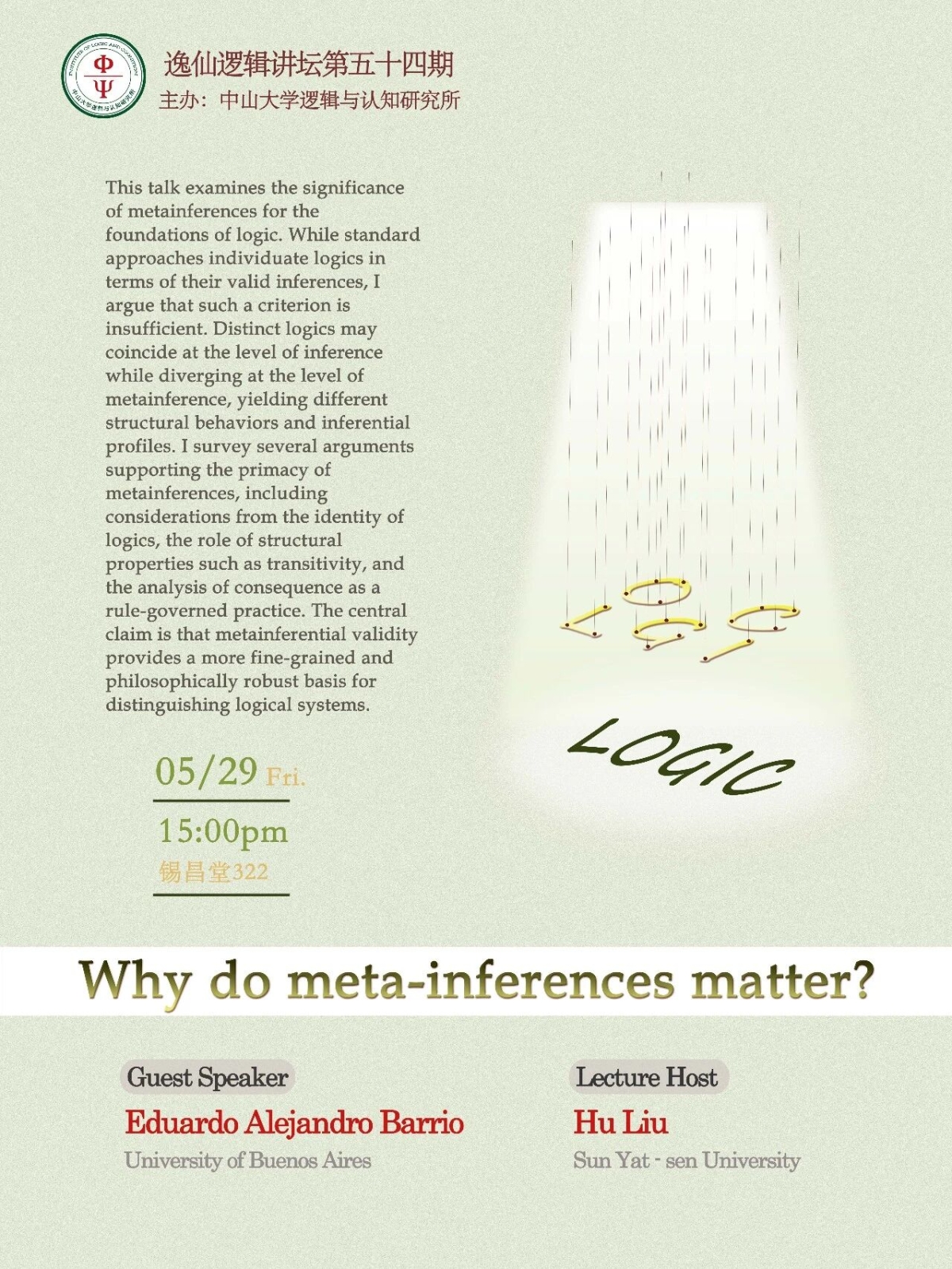
第五十四期 逸仙逻辑讲坛
题 目:Why do meta-inferences matter?
主讲人:Eduardo Alejandro Barrio 阿根廷布宜诺斯艾利斯大学 教授
主持人:刘虎 探花合集 逻辑与认知研究所 教授
时 间:5月29日(星期五)下午15:00
地 点:锡昌堂322室
主办方:探花合集 逻辑与认知研究所
主讲人简介

Eduardo Barrio is Senior Researcher at the National Scientific and Technical Research Council (CONICET) and Full Professor of Logic at the University of Buenos Aires. His research lies at the intersection of philosophical, mathematical logic and AI, with a particular focus on non-classical logics, especially substructural frameworks, and on the study of metainferences and non-standard notions of logical consequence. He has directed and participated in international research projects funded by the National Endowment for the Humanities (USA), the British Academy (UK), the DAAD (Germany), the DFG (Germany), the ECOS program (France), and the EU Marie Skłodowska-Curie Actions, fostering sustained international collaboration. He is the director of BA-Logic, a research initiative devoted to contemporary logic. His work has appeared in leading journals such as Journal of Philosophical Logic, Review of Symbolic Logic, Studia Logica, Synthese, and Analysis, among others. He recently edited the volume Metainferences in Substructural Logics (Springer), which brings together central contributions on the role of metainferences within non-classical systems. He is also Associate Editor of Analysis (OUP).Eduardo Barrio,阿根廷国家科学技术研究委员会高级研究员、布宜诺斯艾利斯大学逻辑学教授。其研究聚焦哲学逻辑、数理逻辑与人工智能交叉领域,主攻非经典逻辑(尤以子结构逻辑体系为核心),并致力于元推理及非标准逻辑后承关系研究。Barrio教授主持及参与多项国际科研项目,资助机构包括美国人文基金会、英国学术院、德国学术交流中心、德国科学基金会、法国生态合作计划及欧盟玛丽・斯克沃多夫斯卡-居里行动计划,推动了长期稳定的国际学术合作。Barrio教授是布宜诺斯艾利斯逻辑学研究计划(BA-Logic)负责人,该计划专注于当代逻辑学前沿研究。其学术成果发表于《哲学逻辑期刊》《符号逻辑评论》《逻辑学研究》《综合》《分析》等国际顶尖期刊。近期主编《子结构逻辑中的元推理》一书,汇集了非经典逻辑体系下元推理研究的核心成果,同时担任牛津大学出版社期刊《分析》副主编。
讲座摘要
This talk examines the significance of metainferences for the foundations of logic. While standard approaches individuate logics in terms of their valid inferences, I argue that such a criterion is insufficient. Distinct logics may coincide at the level of inference while diverging at the level of metainference, yielding different structural behaviors and inferential profiles. I survey several arguments supporting the primacy of metainferences, including considerations from the identity of logics, the role of structural properties such as transitivity, and the analysis of consequence as a rule-governed practice. The central claim is that metainferential validity provides a more fine-grained and philosophically robust basis for distinguishing logical systems.